· 7 min read · Mokua Mogendi
Fact Graph: what if your business ran on its own rules?
Most businesses I've worked with keep their real rules in spreadsheets, WhatsApp groups and people's heads. Fact Graph writes those rules down and runs the business from them. Here is what it does, what it doesn't do yet, and why I think it matters for African businesses.
On every farm I have managed, from Khartoum to Vientiane to Doha, the most important rules were never written anywhere a computer could check them.
Who may approve a purchase over a certain amount. How a farmer's delivery is graded. What gets deducted before the farmer is paid. Which lot can leave the cold room, and who signs it out. Those rules lived in a supervisor's head, in a spreadsheet that three people edited, or in a WhatsApp thread. When two of those sources disagreed, nobody could say which one was right.
That is the problem Fact Graph sets out to solve. I work with the team behind it as Chief Financial Officer of Scan.ly, and through Scanly Kenya I bring it to businesses here. This article explains, without the technical language, what it is and why I think it matters.
Software makes you choose#
When a business wants to get organised, it usually has three options.
Buy an app. It almost fits, so the business bends to fit it. Your rules end up hidden in its settings, or nowhere.
Build your own. It fits until the next change. Every change becomes a project, and someone has to keep the code alive. Most small and mid-sized businesses in Africa can't afford that, and the ones that can often end up with software that nobody remembers how to change.
Stay on spreadsheets and messages. Flexible and fast, until two of them disagree.
Each option has the same weakness: the rules of the business end up somewhere nobody can read them, so nobody can check them.
Write the business down, and let it run#
Fact Graph takes a different route. Instead of an application, you describe how your business works as precise rules, and an engine runs them. There is no application code to maintain: the rules are the application.
It rests on three ideas.
One record of everything that happens. Every action is recorded once: who did it, in which role, under which rule, and when. Nothing is overwritten. If something was wrong, the correction is recorded too.
Rules checked before anything happens. Each rule says what may be done, by whom and when, and every condition is written as a plain sentence. If a request breaks a rule, it isn't recorded, and the person sees that sentence explaining why.
Numbers worked out, never typed. Every list, total and report is calculated from the record for the person looking at it. Because no figure is typed in by hand, there is nothing to keep in sync, and the report always agrees with the orders.

What that looks like on a farm#
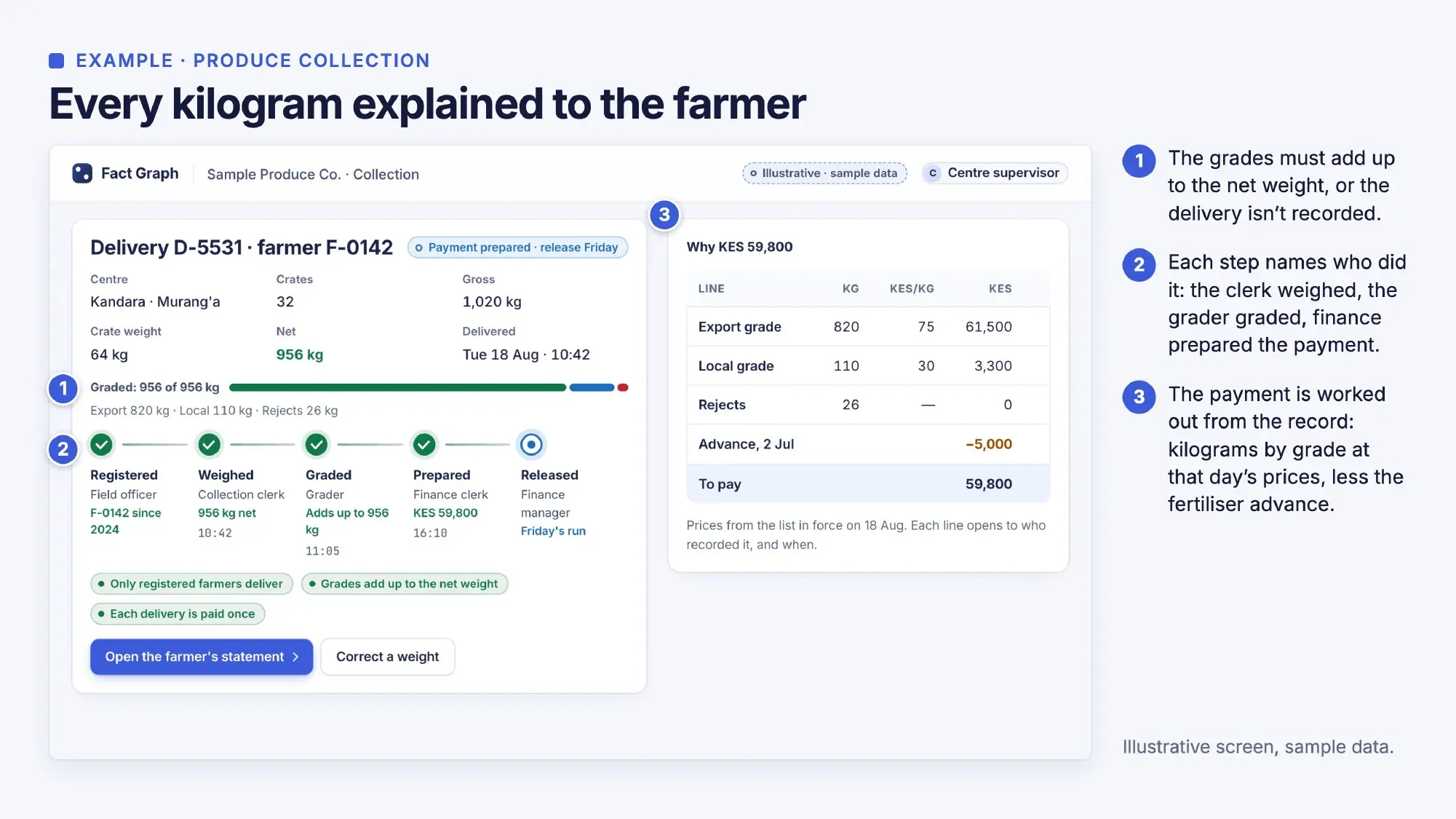
The Fact Graph overview includes an example that will look familiar to anyone who has run a produce collection centre in Kenya.
A farmer delivers to a centre in Kandara, Murang'a. The net weight is 956 kg. The grader records 820 kg as export grade, 110 kg as local grade and 26 kg as rejects. Those three figures add up to exactly 956, so the grading is accepted. If the grader had typed 830 kg for export, the grades would no longer add up, and the system would refuse to record them, showing the rule in plain words: the grade weights must add up to the net weight.
Each step names the person who did it: the clerk weighed, the grader graded, finance prepared the payment. The payment itself is worked out from the record: kilograms by grade at that day's prices, less the farmer's fertiliser advance. In the example that comes to KES 59,800, and the farmer can see exactly how.
Anyone who has handled disputes at a collection centre knows what that is worth. The argument stops being "you cheated me" against "no, I didn't" and becomes "here is what was weighed, by whom, and how the payment was calculated."
The same approach carries through the rest of the chain in the examples: a short delivery keeps the order open instead of disappearing, an export lot can't be released until its dry matter test, residue pass and phytosanitary certificate are on file, and a temperature reading above the limit puts every lot in that cold room on hold until the quality officer clears it.

That last point matters for exporters. A buyer can be shown every kilogram traced to a farmer number, a county and a delivery date, including the cold-room problem and how it was cleared, while the farmers' names and phone numbers stay with you.
AI that works under your rules#
AI is part of Fact Graph, but in a specific, limited way.
An AI assistant, which Fact Graph calls the Consultant, writes the rules with you. You describe how your business works, and it drafts the rules and checks them against worked examples you give it. When it finds a gap or a contradiction, it asks. In one live build the team ran, it noticed that a brief said the base manager approves requests first, but also that nobody may approve their own request. It raised that and asked how to handle it, with a recommendation. It asked twenty questions in all before the rules were complete, and all five worked examples from the brief passed.
AI agents can also do routine work inside the business, such as drafting a purchase order from an approved request. Each agent holds a role, the same way a person does, and the role says what it may and may not do. An agent can never adopt a change to the rules. A named person in the business does that.
Changing the rules without a project#
Businesses change. Approval limits move, a new crop comes in, a buyer adds a requirement. With most software, each change is a project.
In Fact Graph, a proposed change is shown side by side with the rules in force, and every worked example is run against both versions, so you can see exactly what will change before it does. A named person adopts the new version. Past records keep the rules they were made under, so history is never rewritten.
Your data stays with you#
Fact Graph is designed to run on a server you own, called your hub, in your own building. It answers to your people, not to the company that sells it, and it keeps running if you stop paying.
Each person is admitted by name and signs in with their own passkey, and each sees only their part. A crew member sees the requests they raised; the person who approves large purchases sees only what needs them. Who may see each figure is itself a rule.
For businesses where the internet drops, work on site is designed to continue and catch up when the connection returns. The team proves that on your own site during setup rather than promising it on paper.
Why this matters for Africa, and beyond#
Many of the businesses I work with have outgrown spreadsheets and WhatsApp groups but can't justify a custom software project. They need records that hold up when a buyer, a lender or an auditor asks how a number was reached. They work with connections that fail. And they want to own their data.
Fact Graph was built with those conditions in mind: rules a manager can read, one record that settles disputes, a server on your own premises, and AI that helps without taking decisions it shouldn't. None of that is specific to Africa. It applies to any business that records its work, which is why the examples run from equipment maintenance and transport to cold storage and food processing.
Where it stands today#
I would rather be clear about this than oversell it.
Fact Graph is pre-release. The rule engine, the record of every action, privacy by role and the AI Consultant are running today on the team's own hub with test data. Your own screens, connections to payments and accounting, the installer for your hub and working through outages are built with you during setup. No business runs on it in production yet.
That is why the team works through pilots. You start with one process, the one that costs you the most time or money: approvals, stock, maintenance, produce collection or payments. The team installs the hub, the Consultant writes the rules with your people, and it runs beside your current process until they accept it. Nothing has to be scrapped to judge it. What the team guarantees is that the scope agreed in writing can be represented and run on your hub. What nobody can guarantee is that people will record their work, and running it beside the current process shows whether they do.
Try it#
If your business has one process that keeps costing you time or money, it is a good candidate for a pilot. Fact Graph is also looking for resellers: people who know businesses and how they run, and can help scope the first process and support customers locally.
Start at fact-graph.com. If you are in Kenya or East Africa and want to talk it through first, send me a message and I'll help you work out whether your process is a fit.
- fact graph
- business software
- agribusiness
- traceability
- kenya
- ai
