· 7 min read · Mokua Mogendi
Someone has to feed Kenya: why agriculture is the country's future
In September 2026 Kenya signed for up to 540,000 tonnes of Zambian maize. More people, a shrinking stock of good farmland and a dry country make that deal a warning. They also make farming the most certain business in Kenya. Here is the case, with the numbers.
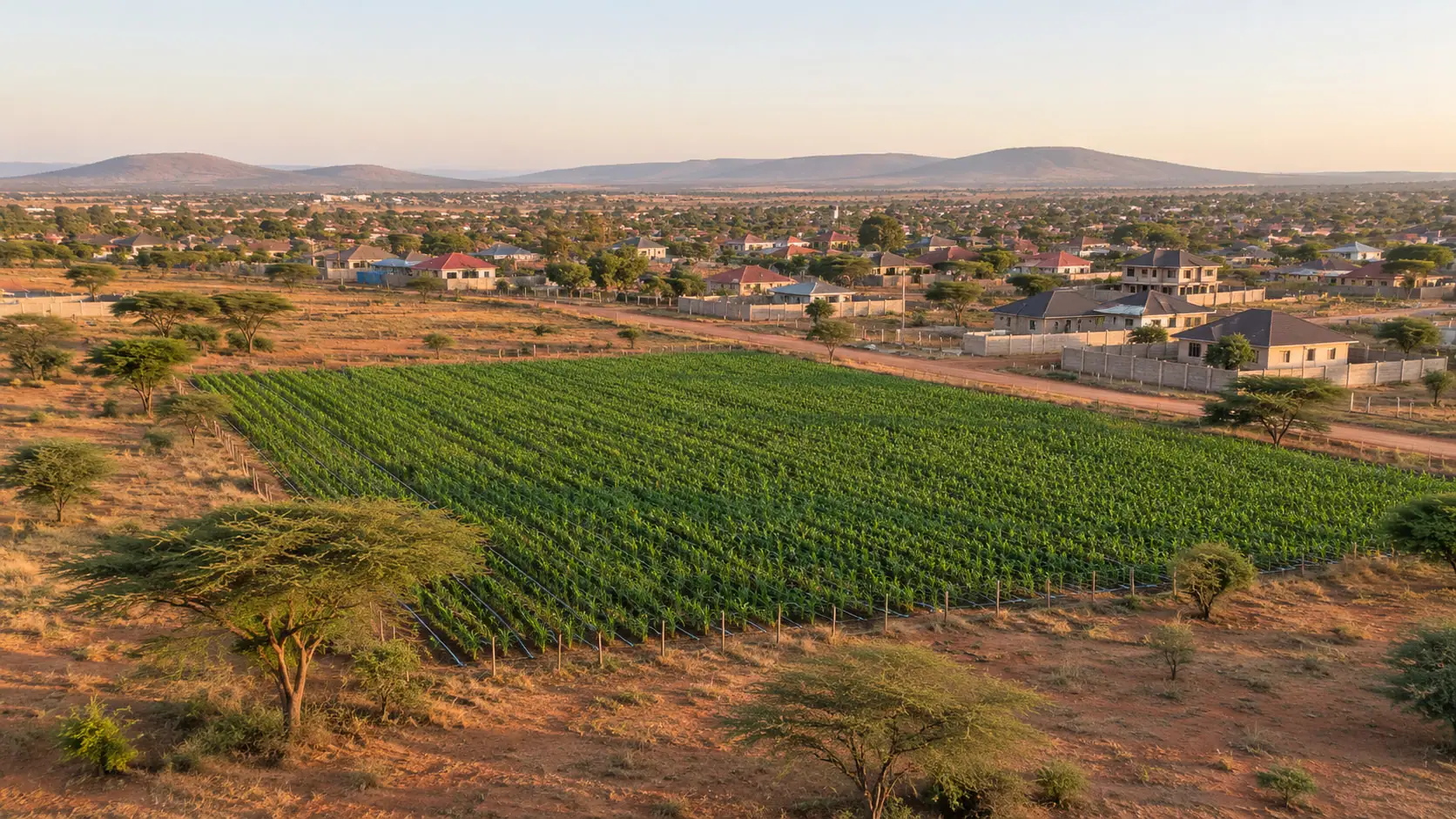
On 9 September 2026, Zambia's Food Reserve Agency signed an agreement in Lusaka to sell a Kenyan company up to 540,000 tonnes of white maize, delivered in six batches over about eighteen months. Zambia had just brought in more than 5.1 million tonnes, its largest harvest on record. Kenya was heading the other way. A long dry spell across western Kenya in June and July cut the national maize crop to 2.2 million tonnes, according to a US Department of Agriculture projection, and by August the cheapest 2 kg packet of unga was selling for Ksh 163.
The deal will help. Families need flour this year, and buying from a COMESA neighbour duty-free is sensible. But it should also make us uncomfortable. A country whose economy rests on farming is relying on another country's rain to feed itself.
I have spent fourteen years running farms, in Kenya and in places much drier than most of Kenya: Khartoum, Doha, the Ethiopian lowlands. What I take from the numbers below is not that Kenya is doomed to import its food. It is that agriculture is the one industry in this country whose customers are guaranteed to keep growing, and that we are not yet farming as if we believed it.
More people every year#
Kenya counted 47.6 million people in the 2019 census. The UN puts the population at about 57.5 million in 2025 and projects roughly 84 million by 2050. That is around 26 million more people to feed within one working lifetime, more than the entire population of Zambia today.
Most of those people will live in towns. They will not grow their own food, and they will buy more of it processed and packaged: flour, cooking oil, rice, milk, eggs, meat. Demand for food in Kenya is not a forecast that might fail. It is arithmetic.
The land we actually have#
The problem is that Kenya is a dry country with a green reputation.
More than 80 per cent of Kenya's land is arid or semi-arid, the ASALs, and some estimates go as high as 89 per cent. Only about 16 to 20 per cent of the country is medium- or high-potential farmland, the band of reliable rainfall and good soils that runs from the central highlands to the west. That fifth of the land feeds most of the country.
And that fifth is exactly where towns want to grow.
Drive out of Nairobi through Kiambu and you can watch it happen. Kiambu has more land under coffee than any other county, yet coffee and tea estates are being subdivided for housing. Juja Farm, once sisal fields, is now one of the fastest-growing property markets in the county. Kiambu's own governor has warned that the county risks food shortages as farms turn to concrete, and the same pattern is spreading around Machakos and Nakuru. Each subdivision makes sense to the family selling. Added up, the country is building over its best soil.
Meanwhile, almost all of Kenya's farming still waits for the sky. Less than 3 per cent of arable land is irrigated. The country has developed about 169,000 hectares of irrigation, roughly a third of the 540,000 hectares its surface water could support, against an estimated 1.3 million hectares if storage and groundwater are counted. When the rains fail in the west, as they did this year, the whole country feels it in the price of unga.
Hunger is already here#
This is not a future problem.
In February 2026 the Integrated Food Security Phase Classification counted about 3.3 million people in the ASALs facing crisis-level hunger or worse, a 72 per cent rise from 1.8 million the previous August. By September, the Kenya Food Security Steering Group put the number needing food aid at 3.5 million. Most of them live in the northern and eastern counties where farming and herding depend entirely on rain.
The bill shows up in the national accounts too. Food and beverage imports rose by a fifth, to Ksh 169 billion in the first half of 2026 alone. Kenya imports over 80 per cent of its wheat, about 75 per cent of its rice and more than 90 per cent of its edible oil. Agriculture is still about 23 per cent of the economy and employs around 40 per cent of working Kenyans, but in 2025 it grew by only 2.8 per cent, held back by erratic rain.
Put those facts side by side. A sector that employs four in ten Kenyans is growing slower than the number of mouths it has to feed, while the country sends hundreds of billions of shillings abroad every year for food it could grow.
Why I read this as an opportunity#
Every shilling in that import bill is a customer already paying for food that someone, somewhere, produced. That is the most bankable demand an investor can ask for. Nobody needs to be persuaded to eat.
The ASALs are not wasteland. They are land without water management. In Sudan I managed 4,500 acres under centre-pivot irrigation, and we raised monthly output by two-thirds. In Qatar I ran a regenerative farm in one of the driest places on earth. Neither of those places has better natural conditions than Kenya's semi-arid counties. What they had was water infrastructure, good management and someone accountable for the numbers.

The gap is mostly water, and water is an investment problem. Two-thirds of Kenya's surface-water irrigation potential is unused. The government published a National Irrigation Sector Investment Plan in 2025, and dams, boreholes, water pans and drip systems all pay back faster when the crop they protect is one the country already imports.
Import substitution is a ready-made market. Rice, wheat, edible oils and animal feed are bought in bulk, by known buyers, at prices set by imports. A grower who can supply them consistently, at quality, does not need to find demand. It is already there.
The ASALs suit crops and animals the highlands don't. Sorghum, millet, green grams, cowpeas, cassava and pasture are drought-tolerant and in demand from brewers, feed millers and processors. These counties already carry much of Kenya's livestock. Fodder under irrigation, better breeds and cold chain turn herding into a business that can survive a dry year.
What has to change#
None of this happens by itself. From what I have seen on farms here and abroad, five things decide whether Kenyan agriculture keeps falling behind its population or gets ahead of it.
- Water before seed. Every serious farm plan in Kenya should start with where the water comes from in a bad year, not an average one. Water harvesting, storage and drip should be the first line of the budget, not the last.
- Protect the best soil. Counties need land-use plans that keep high-potential farmland farming, and incentives for building on poorer land instead. Once a coffee estate becomes a housing estate, it does not come back.
- Run farms as businesses. Records, costings, yields per acre and a manager accountable for them. The farm I took over in Ethiopia went from a 4 million birr loss to a 780,000 birr profit within a year, mostly by measuring and managing what was already there.
- Know where food comes from. Buyers, banks and export markets increasingly want proof of how produce was grown. Traceability is what gets a smallholder's crop into a supermarket or a European shipment, and it is what lets lenders see a farm well enough to finance it.
- Bring patient capital. Diaspora Kenyans, local investors and foreign partners all have a role. Most need a trusted partner on the ground to find land with clean title, set up the company and run the operation. That is often the difference between a farm and a failed project.
Someone has to feed Kenya#
The Zambian maize will arrive in its batches, prices will ease, and it will be tempting to treat this year as bad luck. It wasn't. It was a preview. The population will keep growing, the towns will keep spreading, and the rains will keep becoming less predictable.
Kenya can respond by importing more every year, or by growing more of its own food on land it is not yet using well. The second path is harder. It needs water, management and money. It is also the one that creates jobs at home, keeps shillings in the country, and turns the dry 80 per cent of Kenya into productive land.
Someone has to feed 84 million Kenyans. I would rather it were Kenyan farmers.
If you are thinking about investing in farming in Kenya, whether that means buying farmland, setting up irrigation or finding a partner on the ground, tell me what you have in mind.
- kenya
- food security
- agribusiness
- irrigation
- asal
- investment
